
June 8, 2026
Congratulations to ME graduate students Alex Eagan, Liam Knudsen and Janie Johnson for receiving the National Science Foundation (NSF) Graduate Research Fellowship Program (GRFP). The students are working to improve marine energy technologies, advancing manufacturing for composite materials and broadening our understanding of sports injuries.
The GRFP recognizes and supports outstanding graduate students pursuing STEM degrees who demonstrate the potential to make significant contributions to the field.
Alex Eagan: Improving wave energy converters
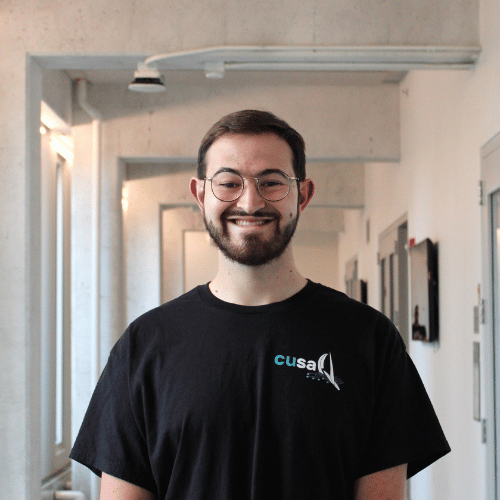
Alex Eagan
Wave energy converters (WECs) capture wave energy and convert it to renewable power. ME graduate student Alex Eagan received the GRFP for his research, “Physics-based machine learning for wave energy converter control,” that focuses on improving WECs through advanced control systems.
“I am currently developing control algorithms for a WEC deployed in Monterey Bay that will test the increased efficiency possible by utilizing incoming wave elevation predictions,” Eagan says. “I’m also interested in demonstrating how physics-informed machine learning in WEC control balances interpretability and efficiency. This approach could accelerate development, in turn helping facilitate widespread adoption.”
WECs could help power the sensing and tools needed to mitigate damage from extreme weather events that are increasing, Eagan says. In addition, WECs can provide energy in remote and coastal areas, many of which are areas least suited to other forms of renewable energy.
“I have always had a close connection to the ocean and a desire to work on renewable energy, so I was interested immediately after first learning about the Marine Renewable Energy Lab,” says Eagan, who is advised by ME Professor Brian Polagye. “What solidified my interest was the multifaceted nature of the research the lab does and the close collaboration that the lab has with the rest of the marine energy community.”
Liam Knudsen: Advanced manufacturing for next-generation materials
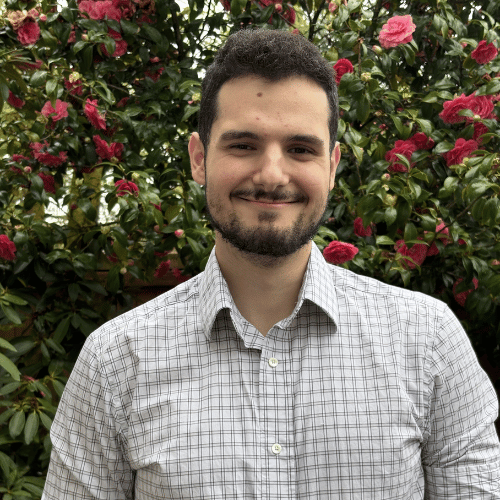
Liam Knudsen
Incoming ME Ph.D. student Liam Knudsen’s research, which received the GRFP, involves developing novel advanced manufacturing techniques for next-generation composite materials, with applications in the areas of energy, sensors and soft robotics. He specifically focuses on using high-precision manufacturing methods to control microstructures and functional properties during processing.
“By integrating precise fabrication methods with intelligent material design, I aim to improve the performance of composites, primarily in the domain of electronics and thermal management,” Knudsen says. “To me, this work is important because it offers a pathway to bridge lab-scale discoveries with manufacturing approaches that enable real-world applications and impact.”
As a bioengineering undergraduate curious about advanced manufacturing, Knudsen discovered the iMatter Lab, led by ME Assistant Professor Mohammad Malakooti. He was drawn to the lab because of its intersection of advanced composite materials and novel manufacturing processes with the goal of developing new stretchable electronic technologies.
“The highly collaborative research environment present in the iMatter Lab along with strong mentorship of my advisor and senior graduate students has been a key factor in my decision to continue in the group for my graduate studies,” he says.
Janie Johnson: Understanding the cellular-scale mechanics of sports injuries in females

Janie Johnson
ME Ph.D. student Janie Johnson became interested in mechanobiology, or how mechanical signals and physical forces influence biological activities, when she tore her rotator cuff while playing volleyball in high school.
“I was curious what was happening at the cellular level that could cause so much pain without the rubber band-snap type of feeling I used to imagine in acute sports injuries,” she says.
Johnson now studies crosstalk in cellular signaling between mechanotransduction, the conversion from mechanical forces into biochemical stimuli, and hormones. She received the GRFP for her research, which looks at estrogen as a potential factor in the poorer outcomes females experience in meniscus tears and surgical repair.
“I use mechanical bioreactors and tissue structure-mimicking biomaterials to examine sex differences in primary human progenitor and meniscus cell responses to physiological and injurious applied strain in the presence of sex hormones,” Johnson says. “Our menisci experience both tensile and compressive loads with every step we take, and this research has the potential to impact musculoskeletal health across populations from the prevention of sports injuries in adolescent athletes to interventions for osteoarthritis in older adults.”
Johnson joined the interdisciplinary Tissue and Regenerative Engineering (TARE) Lab, led by ME Associate Professor Jenny Robinson, because of the lab’s culture and mission.
“Dr. Robinson provides incredibly personalized and holistic mentorship, which is especially important to my success as I pursue an academic career,” she says. “My colleagues are some of the most multi-talented and driven people I've ever had the pleasure of working with — plus, we have a lot of fun in and outside of the lab.”