
This Graduate Certificate in I-BEAM (Intelligent Battery Engineering and Automated Manufacturing) aims to equip students and professionals with essential skills for the rapidly evolving energy manufacturing industry.
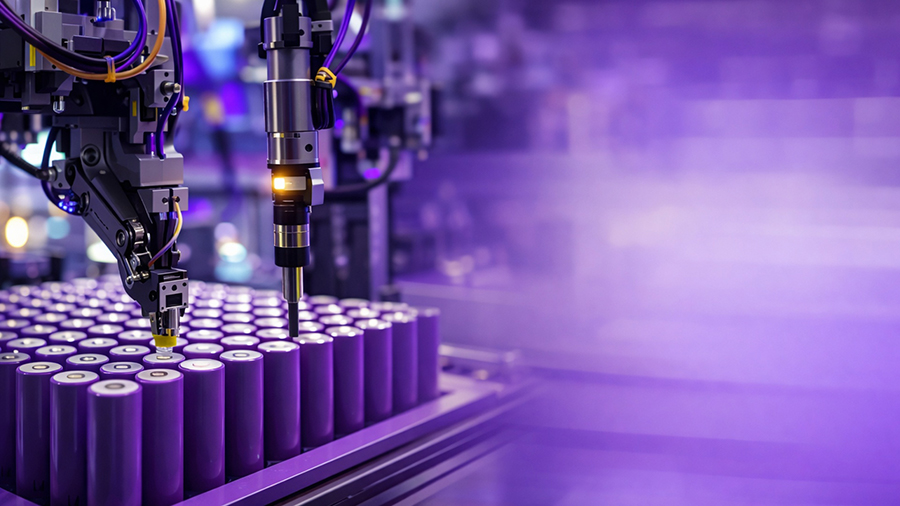
I-BEAM: Intelligent Battery Engineering and Automated Manufacturing
Upcoming terms:
Fall 2026
Priority deadline:
August 3, 2026
LOCATION
Online
DURATION
9 months
TIMES
Mostly
asynchronous
TOTAL COST
$21,000
(estimated)
Program overview
This certificate program aims to cultivate a skilled workforce through targeted education, training, and workforce development tailored to the energy storage industry’s needs, from operators and technicians to Ph.D. level researchers.
Students will acquire comprehensive knowledge spanning the full value chain — from mining and refining to manufacturing and recycling, covering interdisciplinary fields including, but not limited to: materials engineering, advanced characterization for manufacturing (e.g., inline metrology), electrochemical engineering, artificial intelligence and machine learning (AI/ML) for smart manufacturing, supply chain management, modern polymer and ceramic manufacturing for energy applications, robotic defect detection for quality control, and specialized tooling and equipment design.
Learning outcomes
- Identify cost-sensitive steps in the energy manufacturing process that need to be simplified or modified to reduce the overall cost, using a science-driven, cost-focused approach.
- Summarize cell design and fabrication processes, along with cost analyses across different chemistries and production volumes.
- Explain process modeling and simulation techniques for electrode processing.
- Describe manufacturing analytics platform that supports translational battery equipment modification and upgrades by embedding sensors, cameras, and other devices under dynamic conditions.
- Summarize smart manufacturing approaches, including AI/ML and IoT-based closed-loop algorithms for automation, data management, and engineering practice.
- Characterize the manufacturing processes from the atomic level to products by utilizing a range of scientific tools, from in situ experiments to inline metrology.
Upcoming terms: Fall 2026
- Current UW students interested in joining the Fall 2026 term must apply by June 22.
- Registration for non‑UW students for the Fall 2026 term will open in early August.
Curriculum
Students will complete a minimum of 15 credits in 5 courses offered by the Department of Mechanical Engineering and the Department of Materials Science and Engineering. Two courses have been taught in the past from ME and MSE, and five new courses will be added to this program by external instructors from other university/industry/lab partners.
Students have the flexibility to enroll in any of the seven courses individually or complete the full sequence to earn the program certificate.
From grid energy storage and data centers to robotics and electric vehicles, battery technologies are playing an increasingly vital role across a wide range of applications that impact our daily lives. While considerable progress has been made in unlocking the potential of new battery materials in the laboratory, transitioning to large-scale materials and components manufacturing requires addressing scientific and engineering challenges from entirely new perspectives. This course provides a comprehensive overview of advanced battery manufacturing. Covering the full value chain—from raw material extraction to cell fabrication—it explores state-of-the-art materials, electrode processing techniques, cell design strategies, and methods for estimating production costs. A key focus of the course is smart manufacturing which involves using numerical modeling, AI, and digital twins to speed up the process of optimizing electrode and cell preparation.
Instructors: Jie Xiao, Alejandro Franco
This course introduces fundamental artificial intelligence (AI) techniques and their applications in battery manufacturing. Students will learn the mathematical foundations of AI while gaining hands-on experience with data analytics and real-world manufacturing case studies. By the end of the course, students will be prepared to address complex challenges in battery manufacturing and contribute to advancing AI-driven research in the field.
Instructor: Lei Chen
This course covers the fundamentals of equipment design and the integration of sensing technologies in energy manufacturing processes, including batteries, solar cells, and fuel cells. Students will learn principles of sensor selection, system integration, and real-time monitoring, along with data-driven control strategies. Emphasis is placed on how advanced sensing improves process efficiency, product quality, and automation in modern energy manufacturing.
Instructor: Arunachala Mada Kannan
This course examines the supply chain of battery materials, covering raw metals, polymers, lithium compounds, and components such as cell and pack casings. Students will gain a working understanding of the origins, processing, and applications of the diverse materials that underpin battery manufacturing. Industry perspectives will be incorporated, including a featured speaker from Dow Chemical who will discuss the company’s role in the supply chain and the production of polyolefins for industrial applications.
Instructors: Holyun Sun, Chi-Hao Chang
This course introduces cost and market dynamics in lithium-based battery manufacturing. Students will examine the value chain from raw material extraction to cell assembly, with attention to how supply chain constraints, synthesis choices, and process parameters affect cost structures. Case studies highlight tradeoffs in material and process decisions, industry competitiveness, and the influence of global supply chains. Students will gain tools for cost modeling, evaluating cost-performance tradeoffs, and assessing the impact of evolving technologies on manufacturing strategies.
Instructors: Julia Lamb, Nick Grundish
This course aims to explore science and engineering behind manufacturing soft matters in lithium-ion rechargeable batteries, including electrode binders, plastic separators and organic and polymer electrolyte and additives. From polymer materials production, the state-of-the-art processing, and their applications in the batteries will be taught. The knowledge gap between fundamental research and cost-effective materials scale-up for further industry manufacturing will also be discussed.
Instructors: Gao Liu, Alvaro Videla
The development of high-performance, safe, and long-lasting batteries relies on a deep understanding of materials, interfaces, and full-cell behavior. From the atomic arrangement of active materials to the performance of complete battery systems, characterization techniques are essential tools that drive innovation, ensure high quality, and help to detect and solve problems in battery R&D and manufacturing.
In this course, we will explore a wide range of characterization techniques that are indispensable for both battery research and development (R&D) as well as quality control in large-scale manufacturing. We will examine how requirements and optimization goals differ across various applications and across different stages of product development, from laboratory-scale research to pilot scale and industrial production. We will highlight how characterization needs to shift based on specific use cases. A key part of this course will involve examining how characterization experiments can fail, highlighting common mistakes and showing how to avoid them to achieve successful results.
Instructors: Yijin Liu, Katharina Gerber, Zhao Liu
Topics include the history and development of Li-ion batteries and Li-ion battery industry, materials science for electrodes and electrolytes, sciences for processing and manufacturing of battery materials, advanced battery chemistries (redox flow batteries, solid electrolytes), cell design and fabrication, integration, application and requirements in areas such as electric vehicles, medical devices, grid storage, aviation and robotics.
Instructor: Jun Liu
Admission process
Tailor the I-BEAM program to your professional and academic goals. You may choose to:
- Complete all seven courses to earn the I-BEAM Certificate, or
- Enroll in individual courses that align with your interests or immediate learning needs
Instructors
Courses in the Graduate Certificate in I‑BEAM: Intelligent Battery Engineering and Automated Manufacturing are taught by UW faculty alongside industry experts and distinguished professors from other leading universities who are experts in the field.
Full list of instructorsAcknowledgement
This I-BEAM graduate certificate program is based upon work supported by the U.S. Department of Energy under Award Number DE-LC-000L120. Prof. Jie Xiao is the lead PI and she thanks Prof. Luna Huang, Cassidy Anderson and Kuchera Stoddard for their strong support.