
UW mechanical engineering researchers have developed a new way to measure how a blood clot forms in real time, uncovering new insights that could impact cardiovascular research.
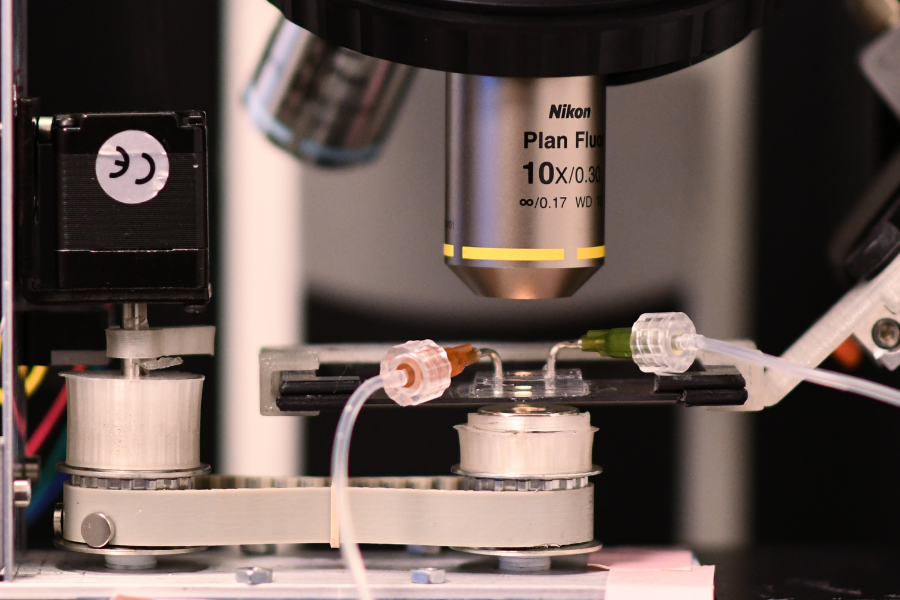
UW researchers created a device that enabled them to track how platelet forces and platelet stiffness evolve together during the first minutes of clot formation. Photo provided by the UW Cell Biomechanics Lab.
When bleeding stops after an injury, it’s because platelets clump together to form a clot. Researchers know that platelets generate forces that help compact and strengthen clots. However, understanding how blood clots become mechanically stable, through measuring real-time changes in stiffness as it forms, has been difficult.
To address this challenge, ME researchers created a microfluidic technology that reveals how platelets respond to mechanical forces during the earliest stages of clot formation.
Their findings, which were published in Advanced Healthcare Materials, reveal that externally applied forces can cause clumps of platelets to strengthen and stiffen through mechanotransduction, a process in which cells convert mechanical forces into biological responses.
“Platelets are often thought of as biological building blocks that stop bleeding, but they're also sophisticated mechanical sensors," says ME Professor Nathan Sniadecki, who led the study with ME doctoral researcher Nikita Taparia. “We found that when forces are applied to a clump of platelets, the platelets respond by actively increasing their stiffness. This demonstrates a dynamic mechanical feedback process during hemostasis, the body’s process to stop a wound from bleeding.”
Measuring clot mechanics
The microfluidic device measures both the forces generated by platelets and the changing stiffness of a growing clot under conditions of blood flow. ME graduate student Ava Obenaus, alum Yoeur-Man Mach (BSME ’22) and alum Nakul Sridhar (MSME ’18, BSME ‘16) participated in the research.
The device contains microscopic silicone pillars and embedded magnetic particles. By rotating a magnet beneath the device, the researchers applied controlled forces to the pillars while blood flowed through the channel. As platelets accumulated around the structures, the magnetic pillars served as force sensors that measured the contractile forces generated by platelets, while simultaneously applying controlled loads to the developing plugs that revealed their stiffness.
This combination enabled the researchers to track how platelet forces and platelet stiffness evolve together during the first minutes of clot formation.
Forces trigger platelet stiffening
The researchers were surprised to find that clot stiffness depends not only on the strength of platelet forces, but also on the magnitude of externally applied forces. It appears that platelets do not simply resist external forces, as many previously believed. Instead, platelets actively respond to mechanical forces within the bloodstream, leading to intracellular signaling and aggregation. Increased magnetic loading led to faster rates of stiffening and an increase in final stiffness.
“Our results show that platelets use mechanotransduction to interpret forces in their environment and alter the mechanical properties of a developing clot,” Taparia says. "The stronger the applied load, the greater the stiffening response. It’s like a game of tug-of-war that the platelets are trying to win."
Platelet activation and contraction is vital to the process of the clot stiffening in response to dynamic loading, the researchers found. The response weakened when they treated blood samples with drugs that inhibit platelet activation and contraction.
Impacts on cardiovascular research
These findings could provide insights into treatments for cardiovascular health and disease. Moving forward, the device could be used to study how new drugs affect clot formation, how platelets respond to mechanical signals when disease is present, and how blood clotting biomechanics contribute to cardiovascular disorders.
“Mechanical properties are critically important in blood clotting,” Sniadecki says. “Clots that are too soft may fail to stop bleeding, while excessively stiff clots are associated with thrombosis, stroke and heart attack. Understanding how platelets regulate clot mechanics could ultimately help us evaluate new therapies for bleeding and thrombotic disorders.”
Originally published September 24, 2026