The UW-led, NSF-funded AI Institute in Dynamic Systems discovers new ways to model and simulate complex, real-world problems.
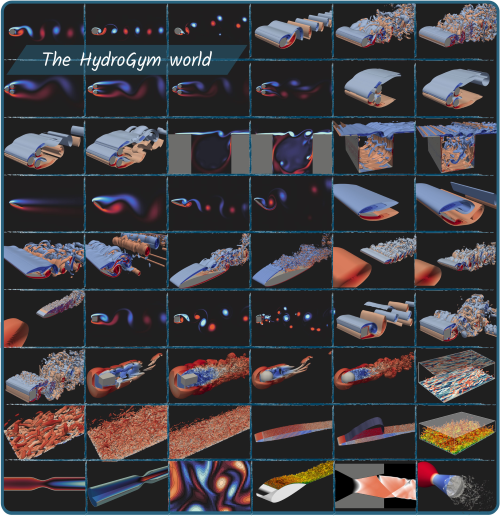
Examples of fluid flow environment simulations in HydroGym, a community platform that provides reinforcement learning agents that can be used to control fluid simulations. Graphic provided by Christian Lagemann.
In its first five years, the AI Institute in Dynamic Systems has discovered new ways to model and simulate complex, real-world problems. The institute, a national collaboration directed by UW mechanical engineering faculty, has released numerous open-source software packages, including the new HydroGym platform that international teams are using to model and control fluid flows.
Now, with a new $20 million grant from the U.S. National Science Foundation (NSF) to fund its next five years, the institute will continue its work to model complex systems and to shorten the process of designing, testing and manufacturing complex engineering systems, such as aircraft and their assembly processes.
The institute’s academic partners include Columbia University, Harvard University, the University of Michigan, Caltech, University of Hawai’i at Manoa, Montana State University, the University of Nevada, Reno, University of Alaska Anchorage, Boise State University, Seattle University, Portland State University and the Colorado School of Mines.
Working on challenging fluid control problems
Fluids — which are involved in designing wind turbine blades, container ships, airplanes and artificial hearts — are central to most major industries. While understanding and being able to control fluids is important, fluid flows are challenging to predict and expensive to simulate.
“The ability to better model, predict and control fluids could lead to a significant economic impact and a massive reduction in carbon emissions,” says ME Professor Steve Brunton, who directs the institute, with ME Assistant Professor Krithika Manohar serving as associate director.
The institute is improving researchers’ ability to control fluids using reinforcement learning, a type of machine learning that involves an AI agent learning from the results of the decisions it makes.
“Reinforcement learning in machine learning has been a powerful technique to solve hard problems, such as controlling full fusion reactors,” Brunton says.
However, simulating fluid flows using reinforcement learning can be prohibitively expensive, involving thousands of simulations so the AI agent can use trial and error to meet a goal. That’s why the institute created HydroGym, a community platform that makes it more accessible for anyone to model and predict fluid flows.
HydroGym contains more than 50 robust fluid flow environment simulations, including cylinder and cavity, and provides built-in reinforcement learning agents that can be used to control fluid simulations. Researchers can test new fluid environments using existing algorithms or test new algorithms on existing environments on the platform.
“HydroGym enables us to move the field forward together so we can build more fuel-efficient vehicles, better wind turbines, improved airplanes and more,” Brunton says.
The platform has already been used to solve an aerospace problem. Ricardo Vinuesa, associate professor in aerospace engineering at the University of Michigan, and his team trained a reinforcement learning agent on a HydroGym fluid flow to reduce drag and friction in an aircraft wing.
Christian Lagemann, former postdoctoral researcher in ME and the AI Institute in Dynamic Systems, is the first author on the paper, with Brunton and Vinuesa co-corresponding authors.
“The next breakthroughs in fluid flow control will require fluid mechanics and machine learning to advance together,” Lagemann says. “We need reinforcement learning algorithms that are more reliable, more sample-efficient and ultimately supported by rigorous performance guarantees. With HydroGym, we want to bring both communities together on a shared platform that dramatically lowers the barrier to entry, so researchers can focus on advancing the science rather than building the tools to get started.”
The UW worked with the University of Michigan, Inha University, KTH Royal Institute of Technology, RWTH Aachen University and the Technical University of Munich on the research.
For the next version of HydroGym, the research team plans to release new fluid environments, including more turbulent flows, as well as new control algorithms. NSF funding will support continued development.
Optimizing the design, test and manufacture process
HydroGym is one example of how the NSF grant will enable researchers to use AI to accelerate the process of designing, testing and manufacturing engineering systems, such as a new airplane or biomedical device. For example, the institute’s researchers could explore how to reduce the multi-year timeline of designing airplane parts, testing different types of composite materials to use and deciding which factories to use to manufacture these aircraft components.
“We plan to develop generative AI methods aimed at dramatically accelerating the design cycle in aerospace applications,” says Vinuesa.
Reducing the cost and time it takes to design, test and manufacture products allows for more responsiveness and customization, Brunton says. Accelerating the design-test-manufacture process could enable engineers to more easily create a wind turbine for a certain location, an artificial heart for an individual’s specific condition, or an airplane that responds to customer needs.
“The opportunity is to close the loop between design, testing and manufacturing,” says Na (Lina) Li, electrical engineering and applied mathematics professor at Harvard University. “By combining AI with feedback, we can use the results of each physical experiment to improve our models and guide the next decision. This continuous cycle of learning can help engineers develop better designs faster and adapt manufacturing processes to real-world conditions.”
AI systems that are part of physical spaces — ranging from manufacturing to robotics to aerospace — involve complex dynamics.
“Unlike chatbots, physical AI needs to deal with challenges that happen in real time, on the edge, and where mistakes can be very expensive,” says Hod Lipson, mechanical engineering professor at Columbia University, one of the principal investigators leading the institute. “Understanding how AI can be used to safely control, operate and improve physical dynamical processes is essential to the next phase of AI.”
The other focus area of the NSF grant is physics-informed surrogate modeling for optimizing the design of complex multi-physics systems, such as an airplane wing.
Boeing is the institute’s primary industry partner, donating $20 million to support research, facilities and faculty development. Other industry collaborations include Google, Amazon, PACCAR, Sierra Nevada Corporation, Toray and Microsoft.
Learn more about HydroGym
See Professor Steve Brunton explain HydroGym in a video.
Originally published October 12, 2026