
October 28, 2026
How do we scale next-generation battery technologies in the U.S.? The UW is a founding partner in a new U.S. Department of Energy (DOE) consortium, the Battery Manufacturing (BattMan) Accelerator. Supported by DOE’s Advanced Materials and Manufacturing Technologies Office, BattMan aims to advance the domestic energy storage industry through research and graduate training.
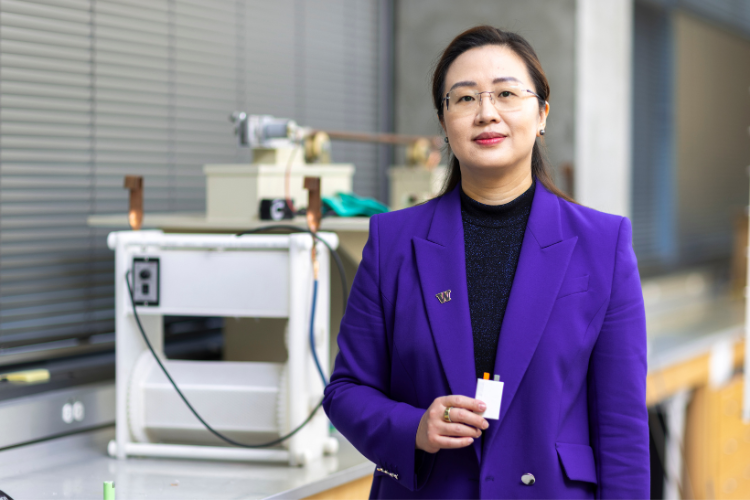
Jie Xiao, Boeing Martin Professor in mechanical engineering with a joint PNNL appointment as a Battelle Fellow, leads the new DOE-supported Battery Manufacturing (BattMan) Accelerator.
The goal of the Accelerator is to establish a unified manufacturing platform that links lab innovation with domestic production. By integrating Super Intelligence (SI)-driven computational learning with physical manufacturing, BattMan will advance manufacturing technologies for the efficient, cost‑effective scale‑up of battery materials, components and next-generation energy storage systems.
Jie Xiao, Boeing Martin Professor in mechanical engineering with a joint appointment at Pacific Northwest National Laboratory (PNNL) as a Battelle Fellow, is the consortium lead, and has been working on batteries for more than 25 years. In recent years, Xiao has become more focused on ensuring battery lab findings are reproducible, scalable and manufacturable for industry, and sharing how academia and industry can work together to achieve this goal.
“The U.S. is an engine of innovation in many ways,” Xiao says. “Now, we need to translate lab findings into scalable, cost-focused scientific solutions to take battery innovation from research to commercialization.”
BattMan is led by PNNL and includes Oak Ridge National Laboratory, Argonne National Laboratory and National Laboratory of the Rockies. In addition to the UW, founding university partners include Binghamton University, the University of Alabama, Arizona State University and the University of Michigan-Dearborn. The program is now forging partnerships with companies in the battery and materials manufacturing industry.
Industry-relevant research and training
One way the consortium will address scientific challenges is by using SI-driven digital manufacturing tools to enhance efficiency. Xiao’s lab is working to develop an SI-assisted framework to quantify defects generated while processing materials. Industry members could then use their own data to validate and train the framework. She is also working with ME Associate Professor Xu Chen to develop a robotic framework for automated electrode defect inspection, capitalizing on Chen’s expertise in aerospace manufacturing processes and high-precision robotic inspection.
Another key role that UW will play in the consortium is to lead the five universities in developing a first-of-its-kind graduate certificate, I-BEAM: Intelligent Battery Engineering and Automated Manufacturing, focused on battery manufacturing and energy storage. I-BEAM is open to industry professionals, national lab employees in addition to graduate and undergraduate students across the country.
“While typical battery-related graduate training might be focused on materials structures or electrochemistry, I-BEAM covers a broad range of topics, from mining to manufacturing,” says Xiao, who developed the certificate program with Luna Yue Huang, associate teaching professor in materials science and engineering. “Students will end the program with a greater understanding of critical mineral extraction, supply chain issues, scalability, smart manufacturing and more.”
For support in launching the program, Xiao credits Kuchera Stoddard, lab administrator at the UW Manufacturing Science and Engineering Lab, and Cassidy Anderson, UW materials science and engineering Ph.D. student and PNNL materials scientist, in addition to UW Engineering and the ME department.
The findings from industry workshops hosted by Xiao helped inform BattMan’s vision and curriculum, which is tailored to the energy storage industry’s workforce needs. BattMan funding supports the launch of the certificate program, providing funding for instructors, teaching assistants and some faculty time.