
ME researchers are harnessing the power of plasma to create new materials and to treat surfaces for advanced manufacturing. Plasma is the fourth state of matter that occurs when atoms or molecules ionize, meaning they develop an electrical charge.
The Composite Materials & Manufacturing Lab, led by ME Assistant Professor Aniruddh Vashisth, recently discovered how radio frequency fields can create plasma that can synthesize new materials — a finding that earned the lab an Army Research Office Early Career Program award. The lab is also using plasma treatment to improve paint adhesion and create stronger composites by developing machines that generate and apply plasma.
A new way to synthesize materials
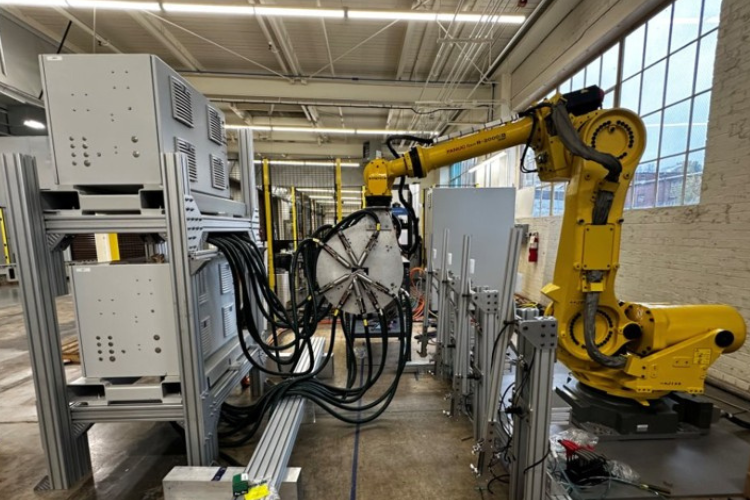
Researchers developed a controlled setup that combines robotics with a 16-nozzle plasma system to treat complex geometries. The system can treat the entire surface of a large part in minutes. Photo provided by Sam Pedigo.
The award-winning project started by accident, when a student was working on using radio frequency to rapidly heat materials.
A researcher in the lab was synthesizing battery materials using a wand-like radio frequency applicator. An electrode in the wand was mistakenly offset, and the team noticed that this created a localized plasma — tiny, millimeter-level lightning strikes — that rapidly synthesized the material. The idea lingered as they worked to understand how the plasma formed.
The surprise discovery led to a new project, funded by the Army Research Office Early Career Program. The Army Research Office operates under the U.S. Army Combat Capabilities Development Command, known as DEVCOM. The project focuses on understanding the fundamental science behind how the radio frequency creates plasma, and how that plasma can rapidly synthesize materials without contact. Plasma’s extreme heat speeds up the chemical reactions that transform one material into another.
This system could potentially synthesize a variety of materials, such as battery components, and fill gaps in objects. First experiments will focus on synthesizing simple ceramics such as silicon oxycarbide, which is used in high-temperature coatings and can be applied to ceramic fiber composites.
“I'm really excited about this project,” Vashisth says. “This method could enable us to do high-temperature manufacturing outside of an industrial oven.”
Treating materials with plasma
Open-air plasma machines treat surfaces with plasma in the form of a flame. Vashisth’s lab completed a project in 2025 that involved treating the surface of composites using plasma torches to improve adhesion. Composite materials are popular because they are lightweight and strong, but adhesion can be challenging because composite surfaces are smooth and don’t naturally bond. Sam Pedigo, UW ME affiliate faculty member, also works on this project.
“We built a system that delivers plasma via nozzles, and used it to treat composites,” Pedigo says. “After testing, we were able to show that if you treat a composite with plasma, you create this nice surface that can adhere to different materials.”
The plasma cleans part of the surface, and tiny electrons break the polymer and create functionalities. Pedigo says these functionalities act as if they’re in a strong handshake with the adherent, making a strong and stable bond. Preparing surfaces with plasma is a more environmentally friendly and less harsh treatment than typical industrial methods, such as flame treatment or acid treatment.
As part of the project, the researchers developed a controlled setup that combines robotics with a multi-nozzle plasma system to treat complex geometries, housed in the UW’s Advanced Composites Center (ACC). The system has 16 plasma nozzles and can treat the entire surface of a large part in minutes.
Vashisth’s lab has launched a new project testing whether integrating plasma treatment with automated fabrication of composites could create stronger aerospace materials. The team is partnering with Mukilteo-based aerospace manufacturer Electroimpact to integrate plasma treatment into an automated fiber placement system at the ACC. Marco Salviato, professor in UW aeronautics and astronautics, and Pedigo, will also work on the research, which is funded by the Joint Center for Aerospace Technology Innovation (JCATI).
Originally published November 2, 2026