
Story by Lyra Fontaine and photos by Dennis Wise/UW Photo
Undergraduate transfer student Thomas Brown hopes to use his engineering skills to improve mobility aids.
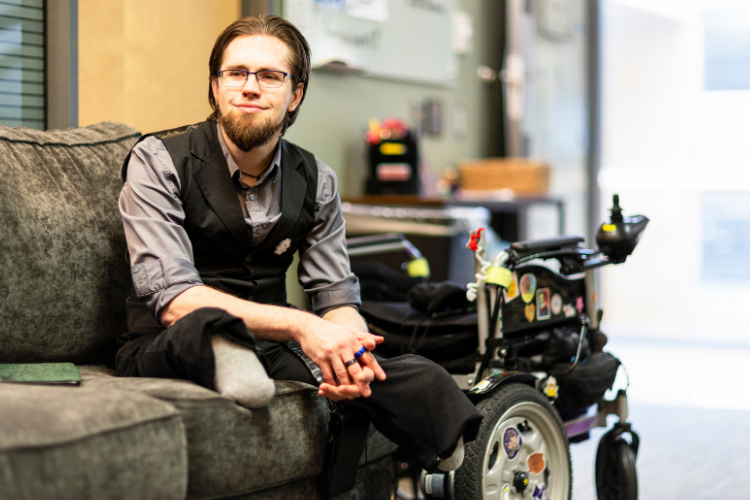
ME undergraduate student Thomas Brown is drawn to biomechanics to improve medical care and mobility for people with limb differences.
Thomas Brown knows firsthand how medical technologies can change your life.
After experiencing two amputations and learning to walk with prosthetic feet, he transferred from Tacoma Community College to the UW in fall 2025. He hopes to get involved with research related to designing mobility aids such as prosthetic limbs that are more comfortable, affordable and accessible.
As an ME undergraduate student, Brown is drawn to biomechanics — applying mechanics to the movement or structure of living organisms — to improve medical care and mobility for people with limb differences.
Changing course
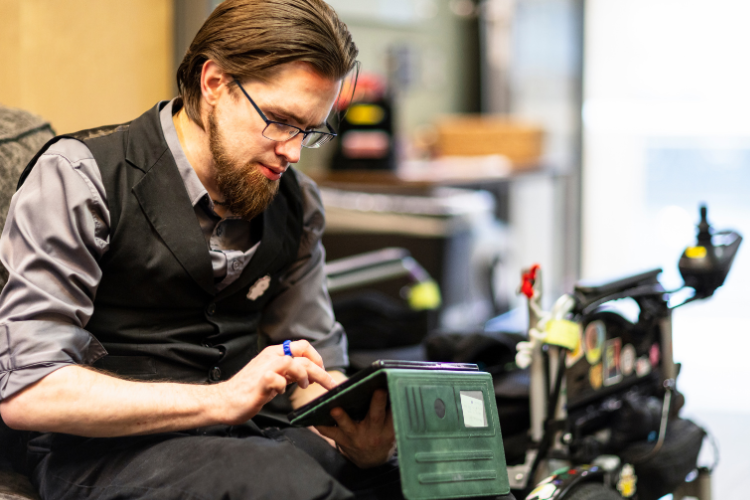
Brown, who transferred to the UW from Tacoma Community College in fall 2025, previously created his own wheelchair.
In 2015, Brown had his left foot amputated due to medical complications, and had further work on his left leg one year later. He was struck by the care and expertise of the nurses who worked with him as he recovered from the surgeries.
“That looks like something I want to do," he remembers thinking. "I want to help people."
He became licensed as a certified nursing assistant and enrolled in nursing at Tacoma Community College. In 2020 while completing prerequisite nursing classes, Brown learned that his right foot would also need to be amputated.
After exploring his options, he decided microprocessor-controlled prosthetic feet were a good fit. An embedded computer processor enables them to constantly adapt, including to changes in terrain, keeping Brown balanced as he walks forward and backward.
The problem is, a pair of microprocessor-controlled prosthetic feet can cost tens of thousands of dollars.
“I’m walking on a new sports car,” Brown jokes.
In addition, he experiences pain from how the prosthetic feet connect to his limbs.
These experiences drove him to change course and pursue engineering instead of nursing. He wondered how prosthetic limb designs could be more affordable and accessible, as well as better connected to the body to reduce discomfort.
The hands-on aspect of engineering also appealed to Brown. While recovering from his second surgery, he created his own wheelchair to help him navigate sidewalk bumps and cracks in his South Tacoma neighborhood. He started with a prototype, tested it, made changes and did more testing.
He ended up with a customized wheelchair that met his needs, including the ability to maneuver it in tight spaces. He used three mountain bike tires for traction and included a braking system that allowed him to go uphill and release the wheels without going backward.
Finding the perfect fit
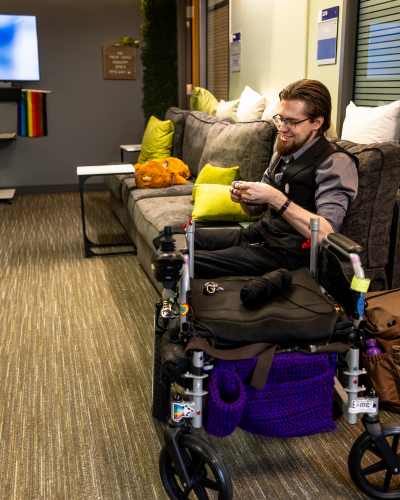
Brown crochets in the The D Center (Disability and D/deaf Cultural Center) at the UW.
Brown received his associate’s degrees in mechanical engineering and material science and engineering from Tacoma Community College, then transferred to the UW in 2025. After talking to his advisor, he switched from a bioengineering major to ME. He realized ME, which has a partnership with the VA’s Center for Limb Loss and MoBility (CLiMB) and has a biomechanics specialization for ME undergraduates, was the perfect fit for his interests.
“I thought, ‘That’s the path I need to follow,’” Brown says.
One course that has made an impact on Brown is ME 411 (Biological Frameworks for Engineers), taught by Professor Nate Sniadecki, which covers the fundamentals of biology, biotechnology and biomechanics.
The class begins with an introduction to biology, such as how DNA replicates and how proteins are made. Students then learn about tissues, muscles and kinematics, or how the body moves.
“It was fun to apply the math and concepts I’ve learned in statics and dynamics to the human body,” Brown says.
The course includes a jump and gait lab, in which students measure the forces they produce by walking or jumping. Brown was excited to participate, contribute a unique dataset and learn more about his movement.
“My gait pattern was nearly identical to a person with both of their feet, which shows how amazing these prosthetic feet are,” he says.
As a third-year student, Brown looks forward to exploring prosthetics development next year for a capstone project. He also hopes to take part in undergraduate research, and has been proactively reaching out to instructors and researchers. The Sanders Lab in the Department of Bioengineering has piqued his interest for their work in developing an adjustable prosthetic socket. If such a design was created for people with a prosthetic foot with a vacuum suspension system, “an adjustable socket would be amazing,” he says.
“My goal at the UW is to use engineering to develop a better system to connect prosthetics to the body,” Brown says.
Originally published March 3, 2026