
By Lyra Fontaine
ME Assistant Teaching Professor Renee Desing shares teaching, research and resources focused on creating environments that inspire student achievement.
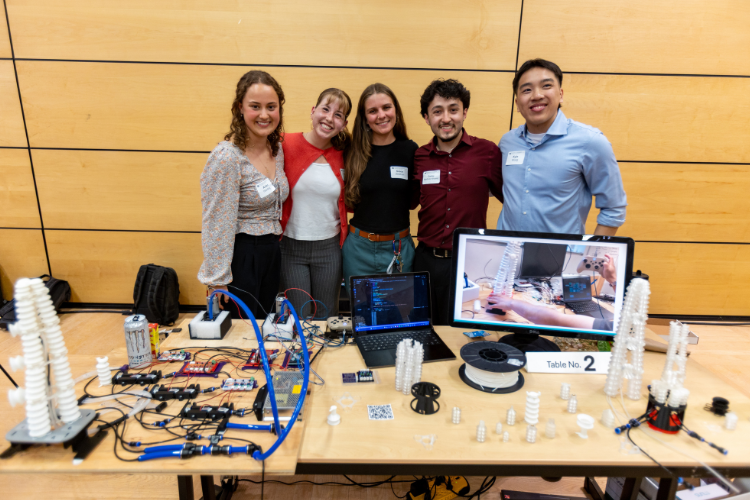
A student team at the 2025 capstone expo that developed soft 3D-printed robotics. Capstone programs like ME’s may be studied as part of engineering education research. Photo by Matt Hagen.
Renee Desing, an assistant teaching professor in ME, recently opened registration for a new class focused on course design and pedagogy for engineering students who are teaching assistants or interested in teaching someday. To her surprise, the class filled up in one day.
As an engineering education researcher and active instructor, Desing has seen growing interest in the topic from students and faculty over the past years.
“There’s a gap because the faculty who are training engineers are experts in their fields, such as fluids or material mechanics,” Desing says, “but they may not have time to dive deep into best practices in the classroom that help set students up for success.”
Desing and other teaching faculty in ME, as well as the UW College of Engineering Office of Inclusive Excellence (OIE), are working to close that gap in support of student success.
Engineering fields benefit when a variety of perspectives and experiences inspire creative, interdisciplinary solutions. To encourage this innovation and evolve with the growing diversity of engineering students, the College provides resources for fostering inclusive learning environments.
Through Desing’s teaching and research, and the centerpiece capstone program, ME is exploring best practices for teaching engineering and preparing students to thrive as working engineers.
Engineering education 101

Renee Desing
Before pursuing engineering education, Desing received a bachelor’s degree from Georgia Tech, a master’s degree in industrial engineering and operations research from Pennsylvania State University, then worked in industry for about a decade. She received her Ph.D. in engineering education from The Ohio State University and her first paper focused on early career experiences of women in engineering and how these experiences impacted their motivation.
Engineering education research, which incorporates social science and STEM education, has expanded in the past 20 years. The field is broad, with the most common study focusing on teaching and learning.
“This might involve trying out a new teaching technique in my classroom to increase engagement or hands-on learning, seeing the impact on students and publishing the results to share lessons learned,” Desing says. “Other instructors can then take these lessons and apply them to their classrooms.”
For example, Desing has applied others’ research on building empathic skills in engineers into modified activities in her classroom.
Researchers in the field might explore what it means to be an engineer, such as the ability to solve problems and be creative, and how that translates into teaching and learning.
“We’re trying to develop students as engineers, so some research involves how students develop an engineering identity and beliefs around ‘smartness’ in engineering,” Desing says.
Translating K-12 best practices about how students learn to university environments is important, too. For example, research might focus on first-year engineering students, capstone programs or how engineering is taught beyond the classroom in research labs or extracurriculars. Engineering education research also involves studying student characteristics and ways to create inclusion, belonging and motivation.
Research to support student success
It’s impactful for students to see their role as engineers as designing for what people need, not what they think people might need”
One way that Desing is fostering the development of students is through teaching Leadership Development to Promote Equity in Engineering Relationships (PEERs), open to all engineering majors.
Desing guides undergraduates as they explore and practice inclusive leadership skills through the lens of their own diverse experiences and perspectives. The class prepares students to become leaders in their future workplaces, as well as in their classrooms and registered student organizations. A leader in a student club might use the skills they’ve learned to improve the inclusivity within a registered student organization, for example.
Guest speakers with disabilities have shared the various tools and technologies they use in everyday life, providing insight into the broader societal impacts of engineering design and how engineers can design for accessibility.
“It’s impactful for students to see their role as engineers as designing for what people need, not what they think people might need,” Desing says.
She and OIE colleagues have written a paper about the impact of PEERs based on student surveys. They also researched the impact of a redesigned math-focused summer program, part of OIE’s STARS program, on first-year engineering students’ preparation and retention.
“Understanding the best ways for students to learn and grow is important because they’re our next generation of engineers,” Desing says. “We need to be able to prepare and support them at an individual level.”
Students have also been involved in engineering education research. ME Ph.D. graduate Ruidong Ma, mentored by Desing, wrote papers reflecting on lessons learned from student teaching as an international student and evaluating a multidisciplinary ME course on artificial organs. The course, co-designed by Ma, aimed to teach engineers skills to help them succeed in interdisciplinary fields, such as careers with healthcare applications.
To support her fellow faculty, Desing runs COE’s yearlong Inclusive Excellence Faculty Fellowship Program. In the first phase, faculty go through weekly training sessions with Desing and experts on topics related to inclusive teaching. The goal is to equip faculty with tools, strategies and best practices to create an inclusive teaching environment. In the second phase, faculty receive support as they update one of their courses to center it around student needs.
Desing wrote a paper about the faculty program’s first cohort that received the Best Paper Award for the Faculty Development Division at the 2025 annual conference of the American Society for Engineering Education. The paper included an analysis of participants’ growth in academic success, cultural competence and critical consciousness.
“Our faculty are seeking tools to create an environment where all students can achieve academic success,” Desing says.
Originally published May 18, 2026