
Photos by Matt Hagen
This spring, ME undergraduates showcased solutions to challenging problems at the capstone expo.
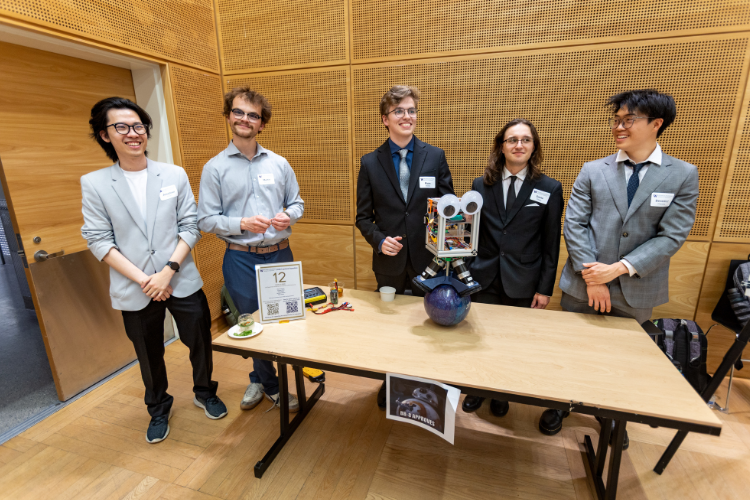
One of the mechatronics teams developed BallBot-8 (BB8), a robot balancing on top of a ball.
Undergraduate students’ professionalism and creative technical solutions were on full display at the 2026 ME capstone exposition. Faculty, industry members and students explored capstone projects such as an efficient surgical cart, a robot that balanced atop a ball, a kayak paddle adaptation, a self-balancing cube and more. Students worked with partners from industry, nonprofit organizations, community groups and research labs to ensure their projects were relevant to the real world.
“Students learn to navigate ambiguity, collaborate across disciplines, communicate with stakeholders, manage constraints, and deliver results, as they will throughout their engineering careers,” says ME Assistant Teaching Professor Sirine Maalej, director of the capstone program.
.png)
A capstone team, sponsored by Blue Origin, created an automated prototype tool that can identify, relocate and install temporary fasteners.
Many teams addressed problems presented by industry partners. A group of students developed an automated prototype tool that can identify, relocate and install temporary fasteners onto the New Glenn launch vehicle for Blue Origin’s factory automation team. For Amazon, a group of students developed and deployed a prototype of an AI-powered occupancy sensor system that reduces energy consumption and operational costs for facilities by automatically adjusting heating, cooling and lighting.
Some projects aimed to improve accessibility, both in and out of the home. Students designed a reproducible pool-accessible wheelchair for Wave Therapies that reduces floating and tipping for aquatic therapy patients. Adaptable House-sponsored projects for users in need of mobility assistance included designing a pivot-based kitchen workstation, an in-home overhead mobility system and a frame to support movement in and around the bed.
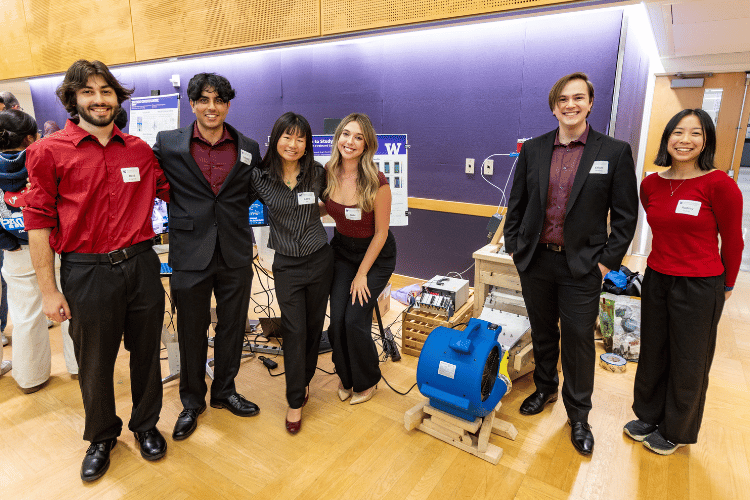
A capstone team developed a wind tunnel to study the spread of wildfires in the western U.S.
Students tackled environmental, biomedical and manufacturing challenges. One team designed, fabricated and assembled a wind tunnel to study the spread of wildfires in the western United States. The tunnel accurately measured the lift and drag of simulated particles in the atmosphere. The team was sponsored by the Combustion, Atomization, Multiphase, & Particulate Physics Research & Education (CAMP-PhyRE) Group, led by ME Assistant Professor John Palmore Jr.
As an outdoor recreation enthusiast, Gabi Laurenz (’26 BSME) was drawn to the goal of better understanding wildfire spread. The capstone also combined her interests in aerospace and fluid mechanics. She says the project was the highlight of her undergraduate education in ME.
“We learned that solving engineering problems requires not only technical ability but also effective communication, collaboration and adaptability,” Laurenz says. “I look forward to carrying these skills forward into my future career and eventually graduate school.”
Capstone expo award winners
- Best Poster/Visual Communication (ME): Active Rest and Recovery: An Exercise/Assist Bed System, Adaptable House
- Best Poster/Visual Communication (Mechatronics): BallBot-8 (BB8), UW ME Mechatronics 12
- Best Design Process (ME): Improved Kayak Paddle Adaptation, Outdoors for All Foundation
- Best Design Process (Mechatronics): Cubli: The Self-Balancing Cube, UW ME Mechatronics
- Judge Choice: Ball on Wheel Control, UW ME Mechatronics
- Inclusive Teamwork Award (individual): Sean McMichael, Kailey Johnson
- Inclusive Teamwork Award (team): Occupancy-Based Control (OBC) Prototype for HVAC Systems Using IoT Sensors, Amazon
Originally published July 13, 2026