
By Lyra Fontaine
ME is building on its robotics strength through advanced research and graduate education programs.
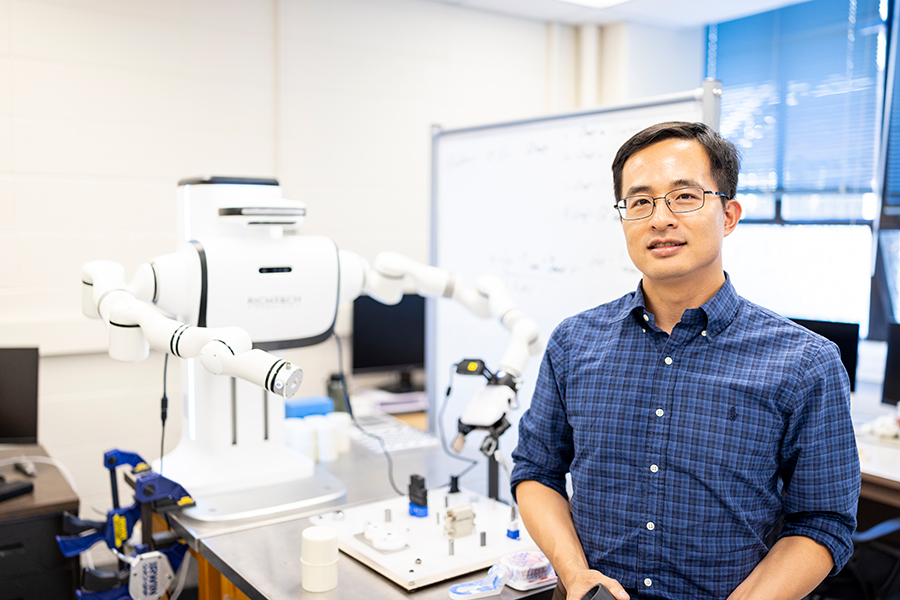
Professor Xu Chen works with collaborative robots for advanced manufacturing tasks. Photo by UW Photo.
Mechanical engineering researchers at the UW have made tiny robots fly, improved robotic grasping and developed automation systems that inspect objects with precision beyond human limits. As part of a broader, interdisciplinary effort across the College of Engineering, the department is contributing its expertise to help launch the UW’s new robotics graduate program this fall.
The robotics industry continues to expand, with more than 500,000 industrial robots installed worldwide in 2024, according to the International Federation of Robotics. As robots become more common in warehouses, hospitals, homes and manufacturing settings, employers need engineers who can design, program and maintain these systems.
Led by the College, the UW robotics graduate program offers a master’s degree and a graduate certificate to provide advanced, hands-on training in robots and related technologies and to help meet local industry demand for talent. Funding comes from industry, the National Science Foundation (NSF), Advanced Robotics for Manufacturing (ARM) and more.
“The UW program will integrate core robotics courses with modern AI tools and physical AI concepts,” says ME Associate Professor Xu Chen, who chaired the cross-college committee that envisioned the program’s curriculum.
The program brings together expertise from across the College of Engineering, including courses taught by ME faculty that build upon the department's existing strengths in areas ranging from aircraft assembly to multi-robot coordination.
“We have demonstrated real impact for manufacturing problems,” says ME Associate Professor Ashis Banerjee. “Our researchers are taking state-of-the-art analytical techniques and putting them to use on robot hardware. We’re not only building robots, but also making them smarter and capable of real-time decision making and therefore deployable in the real world.”
Below, we spotlight how Chen, Banerjee and new Assistant Professor Monica Li Storms are working to improve robotic spatial awareness, explore confined spaces using robotic teams and help robots sense touch and sound.
Understanding object locations
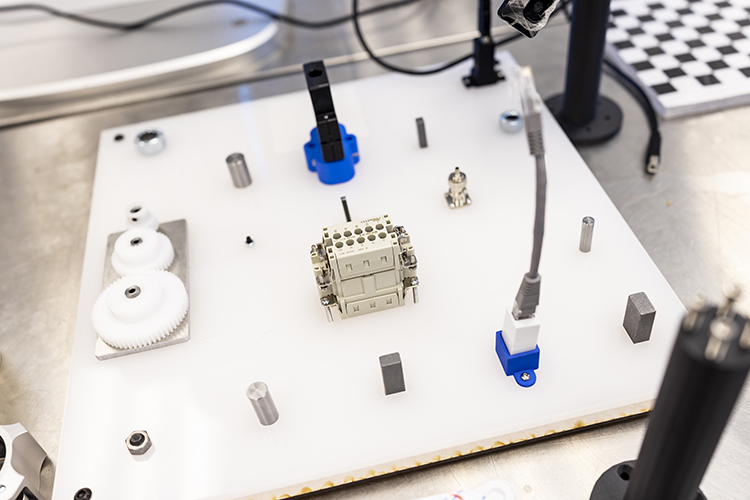
ME researchers created a framework that helps robots identify manufacturing parts by their basic shapes. Photo by UW Photo.
A robot can use cameras to detect objects. However, in manufacturing facilities that make a variety of products in small quantities, it can be hard for robots to determine exactly where an object is and how it’s positioned.
Chen’s Mechatronics, Automation, and Control Systems Laboratory (MACS Lab) has developed a new method enabling robots to achieve precise spatial awareness in real-world manufacturing environments.
“While humans can understand the relative position of different objects in front of us, robots might not know if an object is 1 or 10 meters in front of them in a complex scene,” Chen says. “We’re focused on this important perception stage.”
The researchers created a framework that helps robots identify manufacturing parts by their basic shapes, such as prisms. This approach could be useful in warehouses and factories, where robots need to locate and orient different manufacturing parts such as shells, connectors or supporters.
The method, called iLSPR (Learning-based Scene Point-cloud Registration), uses a digital model library of common industrial objects. It enables robots to align 3D images of objects taken from different angles and to translate complex 3D data into simple shapes.
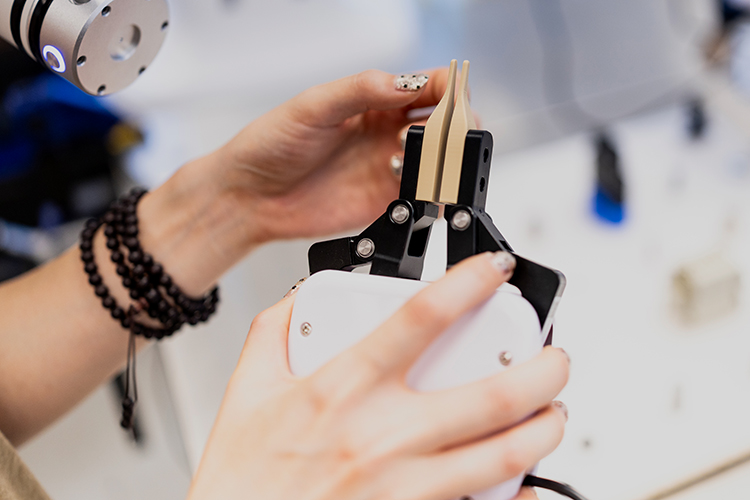
Graduate student Zhongchun Yu demonstrates an end-effector device that attaches to the robotic arm to pick up objects such as wires. The MACS Lab works on robotic spatial awareness, robotic wire manipulation and more. Photo by UW.
To build the library, the researchers created a simulated robotic manufacturing scene, collected computer-aided design (CAD) models of mechanical parts and captured point clouds, which are separate data points that represent the objects. Simulation experiments using NVIDIA architecture, along with validation on a real-world robotic manufacturing system, showed that iLSPR achieves groundbreaking accuracy in position and orientation estimation. After the robot acquires the skill, the learning-based method enables it to recognize and register new objects, like humans would do.
In addition to this project, the MACS Lab has worked on other robotics research using AI to help robots navigate the real world, including automated inspection of manufacturing parts and the use of visual and tactical feedback to help robots grasp objects and detect slip. They are tackling major challenges in robotics, such as the manipulation of wires and other deformable objects in advanced manufacturing.
Sense of touch and hearing

During her Ph.D. studies, Assistant Professor Monica Li Storms designed robot components for marine sampling and tested them on a small remotely operated vehicle (shown here at a field test in French Polynesia), in collaboration with a research team. Photo provided by Storms.
Robots often rely on cameras to “see” the world, using vision as feedback for tasks. But what if the ability to touch and hear was added to a robot’s repertoire? Building ways for robots to sense their environments to improve their performance is a major focus of Storms’ research.
Storms came to UW mechanical engineering from AI robotics company Berkshire Grey because she wanted the freedom to pursue fundamental research with real-world impact. She says that studying robotics offers opportunities to study interesting problems with tangible effects.
“I’m drawn to how robots can physically interact with the world, and how these technologies could have a positive impact on society,” Storms says. “Robots could help us understand our oceans and assist people in daily tasks.”
From a hardware and mechanical design perspective, Storms is working on sensors that can give robots more useful information about their surroundings. She is also studying soft robotics and how flexible grippers may be helpful for manipulating objects in unstructured environments.
During her Ph.D., Storms explored designing soft, textured fingertips for robots that might be used in real-world environments that involve fluids, such as washing dishes or performing tasks in the rain. In addition, she designed a touch sensor that uses sound to transmit information, exploring the interplay between conventionally distinct sensing methods.
Now at the UW, she looks forward to setting up her lab, making robots using the UW’s prototyping facilities such as 3D printers, and collaborating with other researchers.
Exploring confined spaces
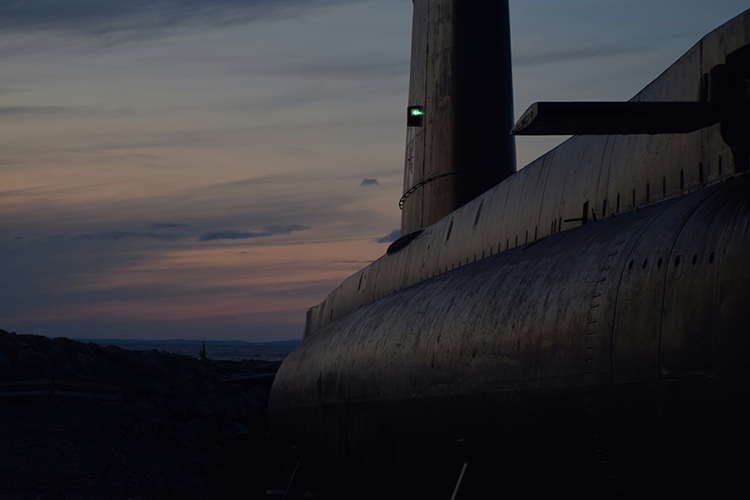
Researchers developed a mathematical framework to help robots explore confined spaces inside ships, submarines and aircrafts more effectively. Photo from Unsplash.
ME researchers are advancing their work on robotic exploration of confined spaces through a three-year project funded by the National Science Foundation (NSF). Ashis Banerjee is co-directing the project with lead researcher Santosh Devasia, the Minoru Taya Endowed Chair in Mechanical Engineering.
Inside ships, submarines and aircraft, tight spaces store objects and critical infrastructure such as pipes, cables and electronics that power devices. These areas — for example, a water tank in a ship that provides stability — require periodic inspections and maintenance, which can be challenging.
The small, dark spaces make it uncomfortable and at times hazardous for people to maneuver while performing detailed inspections, which is why researchers are studying how robots can assist. Banerjee and Devasia’s team has developed a new mathematical framework to help robots explore these spaces more effectively.
“We want the robots to spend more time in areas with critical assets that need to be inspected carefully,” says Banerjee, who leads the Scale-independent Multimodal Automated Real Time Systems (SMARTS) Lab. “Our approach allocates the amount of time spent inspecting different sections in proportion to the amount of useful information robots can extract from these areas.”
Previously, a U.S. Navy-funded project applied this mathematical framework to a single robot. The new NSF project expands the scope to teams of robots and is relevant to both confined spaces and open areas where robot teams could support search-and-rescue missions.
The researchers will tackle new challenges, especially robot-to-robot communication. In open spaces, robots could communicate wirelessly, but in harsh marine environments, robots could instead use optical and acoustic forms of communication.
“We want to limit the information robots exchange with each other because of their limited bandwidth, so each robot just knows the location and tasks of the others,” Banerjee says. “If a robot fails to complete a task, that information will be available to a few other robots.”
Originally published August 25, 2026