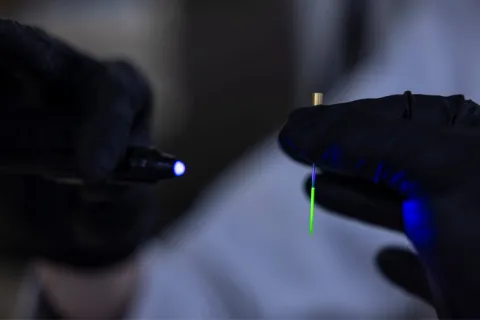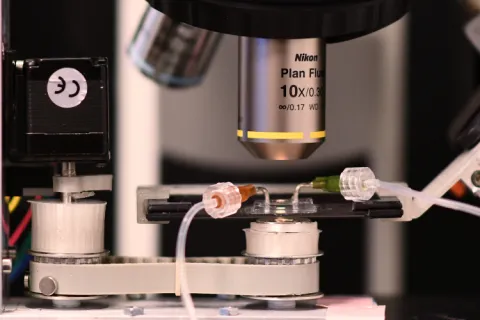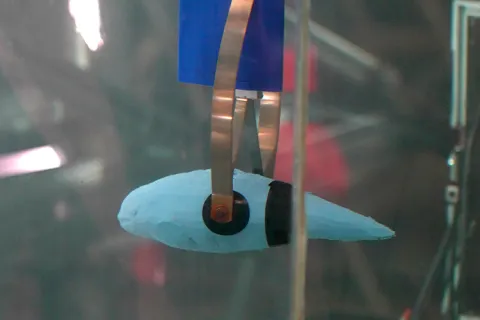
At UW Mechanical Engineering, next-generation materials drive innovations in areas such as advanced manufacturing, robotics, energy, health and medicine, and the environment.
With the ability to test material performance through simulations and build new materials on the micro- and nano-scale, it’s an exciting time to study advanced materials.
How ME is making an impact
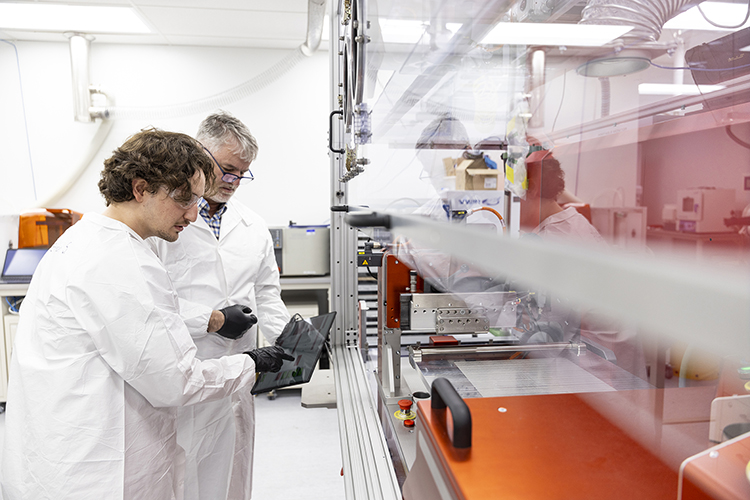
Mechanical engineers in sustainability
ME researchers are using new 3D printing methods to develop energy devices, designing recyclable polymers with AI and more.
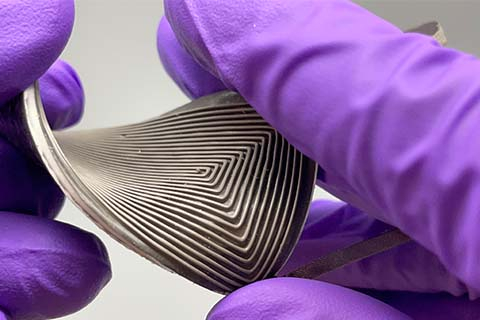
Harvesting thermal energy to power wearable electronics
Assistant Professor Mohammad Malakooti created a wearable thermoelectric device that converts body heat to electricity.
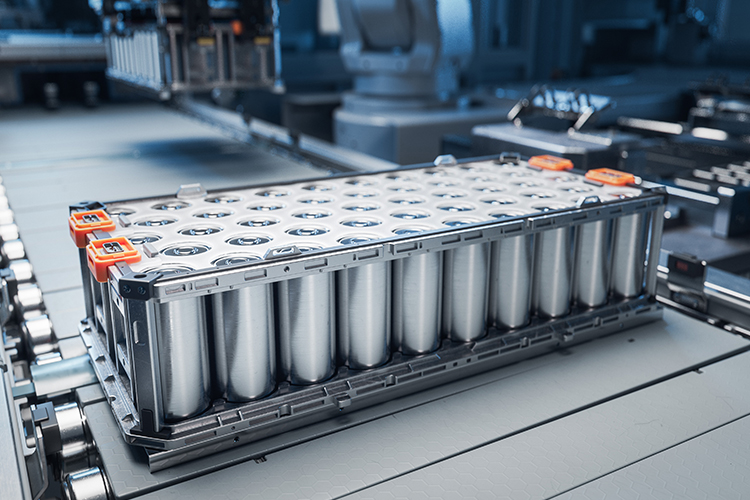
How academia can help battery manufacturing in the U.S.
Professor Jie Xiao discusses battery components and how academia can help support the growing domestic battery manufacturing industry.
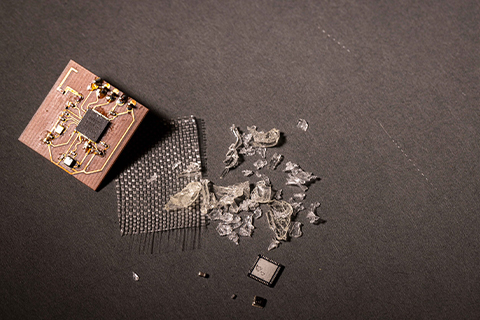
New circuit boards can be repeatedly recycled
A team led by UW researchers, including ME Assistant Professor Aniruddh Vashisth, developed a printed circuit board that performs on par with traditional materials and can be recycled repeatedly.
Research centers and institutes
Advanced Composites Center
The Advanced Composites Center is building a robust innovation ecosystem for industry and academia to advance the field of data-driven methods for composites manufacturing.
Boeing Advanced Research Collaboration
Through the Boeing Advanced Research Collaboration, Boeing-employed affiliate instructors work in the lab side by side with faculty and students on joint research projects in the manufacturing and assembly of aircraft and spacecraft structures.
Clean Energy Institute
The Clean Energy Institute accelerates the adoption of a scalable and equitable clean energy future that will improve the health and economy of our state, nation and world.
Institute for Nano-Engineered Systems
The Institute for Nano-Engineered Systems (NanoES) accelerates the translation of nanoscale research into next-generation products for quantum information sciences, clean energy and medical diagnostics.
All research centers & institutesAssociated faculty
Notable partners and sponsors
Blue Origin, Boeing, Meta, Microsoft, National Science Foundation, Oak Ridge National Laboratory, Pacific Northwest National Laboratory, U.S. Department of Energy.
Application areas
Advanced manufacturing
ME is creating materials that are durable, versatile and sustainable to meet industry needs — such as stronger and lighter composites for aircraft — as well as testing materials to ensure their strength.
Biomedical science and technology
Researchers are developing devices to help improve disease diagnosis and treatment, as well as creating biomaterials to better understand human injury.
Energy
To enhance efficiencies and reduce environmental impacts, ME researchers are engineering batteries and solar cells, creating energy-harvesting materials and optimizing battery storage.
Environment
ME researchers are creating materials for renewable energy technologies, using materials to reduce noise pollution, developing reusable or recyclable plastics for electronics and more.
Robotics
ME is creating advanced materials, such as soft composites, that can enhance robots’ functionality.